Hemorrhoid Banding (Rubber Band Ligation): How It Works, Results, and Risks
Rubber band ligation (RBL), or hemorrhoid banding, is the most widely used and most effective office treatment for internal hemorrhoids. This article explains how it works, who is a good candidate, what results to expect, and the risks. For an overview of hemorrhoids, see hemorrhoids: causes, symptoms, and treatment. To schedule, see our non-surgical hemorrhoid treatment page.
Why banding is painless: the dentate line
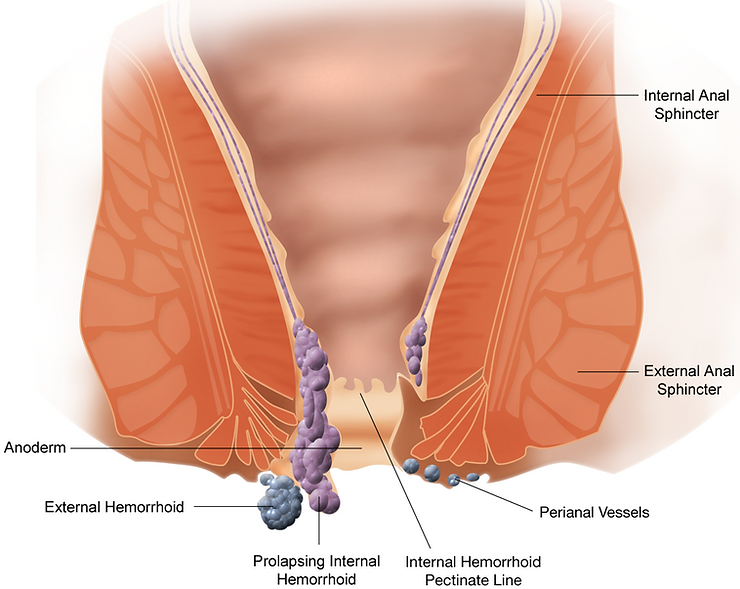
The dentate line is a ring about 2 centimeters inside the anal opening. Below it, the skin has pain nerves. Above it, the lining of the rectum senses pressure and stretch but not pain. Internal hemorrhoids sit above the dentate line, so a band placed at their base, comfortably above the line, causes pressure or fullness rather than pain. External hemorrhoids sit below the line and are never banded.
How banding works
A small rubber band is placed around the base of the hemorrhoid. It cuts off the blood supply, so the tissue shrinks and, over 3 to 10 days, falls off along with the band. The small area that heals forms scar tissue that anchors the remaining lining in place, which reduces prolapse and bleeding over the long term.
Who is a candidate
Internal hemorrhoids are graded by prolapse:
- Grade I: bleeding, no prolapse
- Grade II: prolapse that goes back in on its own
- Grade III: prolapse that must be pushed back in
- Grade IV: prolapse that stays out
Banding is recommended for grade I to III internal hemorrhoids that keep bleeding or prolapsing despite fiber and good bathroom habits, as in the American Society of Colon and Rectal Surgeons (ASCRS) clinical practice guidelines. Grade IV, large external, or mixed hemorrhoids usually need surgery.
When banding may not be right
- External-only hemorrhoids or a thrombosed (clotted) external hemorrhoid
- An active anal fissure, abscess, or fistula
- Perianal Crohn's disease
- A weakened immune system (for example, chemotherapy or uncontrolled HIV), because of infection risk
- A bleeding disorder, or blood thinners that cannot be safely paused
- Pregnancy, when conservative care is usually preferred
Traditional banding vs. the CRH O'Regan System
Traditional banding uses a lighted anoscope to hold the anus open and metal forceps to pull the hemorrhoid into a ligator before the band is released. Several hemorrhoids are often banded at once.
The CRH O'Regan System, which we use in our office, is a small, disposable, syringe-like suction ligator:
- After an exam confirms internal hemorrhoids, the ligator is gently placed and light suction draws the hemorrhoid into the device. No metal clamps are used.
- The band is released at the base of the hemorrhoid. The process takes about a minute.
- One hemorrhoid column is treated per visit. Most people have three columns (left side, right front, and right back), so treatment is usually three visits about two weeks apart. Banding one at a time lowers the chance of pain and other side effects.
- No bowel prep, fasting, or sedation is needed.
Before banding
- We confirm that bleeding is from hemorrhoids. If you are due for colon cancer screening, are 45 or older with bleeding, or have other symptoms, we may recommend a colonoscopy first.
- Tell us about blood thinners (warfarin, apixaban, rivaroxaban, clopidogrel, and others) and aspirin. Do not stop them without talking to the doctor who prescribed them.
- Tell us about diabetes, immune problems, heart valve disease, or pregnancy.
Results
- Most patients with grade I to III hemorrhoids have lasting relief of bleeding and prolapse after a full series of bandings.
- Compared with infrared coagulation and sclerotherapy, banding has a lower chance of symptoms returning, which is why guidelines favor it.
- Hemorrhoidectomy is more durable but far more painful and needs anesthesia and weeks of recovery.
- Hemorrhoids can come back over the years, especially if constipation and straining continue. Recurrent hemorrhoids can be banded again.
Aftercare
- Expect fullness, pressure, a dull ache, or a feeling that you need to have a bowel movement for up to 24 to 48 hours.
- Use acetaminophen (Tylenol) and warm sitz baths for discomfort.
- Take a fiber supplement and drink fluids; add a stool softener or polyethylene glycol (Miralax) if needed to avoid straining.
- Most people return to work the same day. Avoid heavy lifting and very strenuous exercise for a day or two.
- A small amount of bleeding is normal, especially when the band falls off 5 to 10 days later.
Risks and complications
- Discomfort: pressure or a dull ache is common; significant pain is uncommon and usually means the band is close to the dentate line. It may need to be removed.
- Delayed bleeding: when the band and tissue fall off, usually 5 to 10 days later. Heavy bleeding is uncommon but more likely on blood thinners.
- Thrombosed external hemorrhoid: a painful clot can form in a nearby external hemorrhoid.
- Trouble urinating, mainly in the first day.
- Band slippage, which may need repeat banding.
- Pelvic infection: very rare but serious. The warning signs are fever, worsening pain, and trouble urinating.
Call us or go to the emergency room for fever or chills, severe or worsening pain, heavy bleeding or clots, or trouble urinating after banding.
Schedule hemorrhoid banding
We perform CRH O'Regan hemorrhoid banding in our Temple City office. Call 626-898-4560 or book an appointment, and learn more on our non-surgical hemorrhoid treatment page.
Make an appointment
Our gastroenterologists in Temple City care for patients from Arcadia, San Gabriel, Pasadena, Monrovia, Monterey Park, and across the San Gabriel Valley. We accept most PPO plans (see accepted insurances), and our doctors speak English, Vietnamese, and Mandarin. Schedule an appointment or call 626-898-4560.
This article is for general education and is not a substitute for medical advice. Talk with your doctor about your own health.
Quick Answers
Why doesn't hemorrhoid banding hurt?
The band is placed on the internal hemorrhoid above the dentate line, where the lining has pressure nerves but no pain nerves. Placing the band too close to the dentate line is what causes pain.
What makes the CRH O'Regan System different from traditional banding?
Traditional banding uses a lighted anoscope and metal forceps to pull the hemorrhoid into a ligator. The CRH O'Regan ligator is a small, disposable device that uses gentle suction instead of grasping, and only one hemorrhoid is treated per visit, which keeps discomfort low.
How successful is hemorrhoid banding?
For grade I to III internal hemorrhoids, most patients have lasting improvement in bleeding and prolapse after a series of bandings. Hemorrhoids can return over the years and can be banded again.
How many banding sessions are needed?
Most people have three hemorrhoid columns and need about three sessions, spaced about two weeks apart, one column per session.
What are the risks of rubber band ligation?
Mild ache or pressure is common. Less common are bleeding when the band falls off 5 to 10 days later, a clot in an external hemorrhoid, trouble urinating, and band slippage. Severe pelvic infection is very rare; fever, worsening pain, and trouble urinating need urgent care.
Who should not have hemorrhoid banding?
People with external-only hemorrhoids, active anal fissures or infection, perianal Crohn's disease, a weakened immune system, or a bleeding disorder may need a different treatment. Blood thinners raise the risk of bleeding and must be discussed first.